Relaxation (R₁, R₂)
relaxation1d fits a series of 1D spectra recorded with increasing relaxation delay, and returns the relaxation rate. It handles both a plain decay, as in a T₂ or a saturation experiment, and an inversion recovery.
Running the analysis
using NMRAnalysis

results = relaxation1d("11")
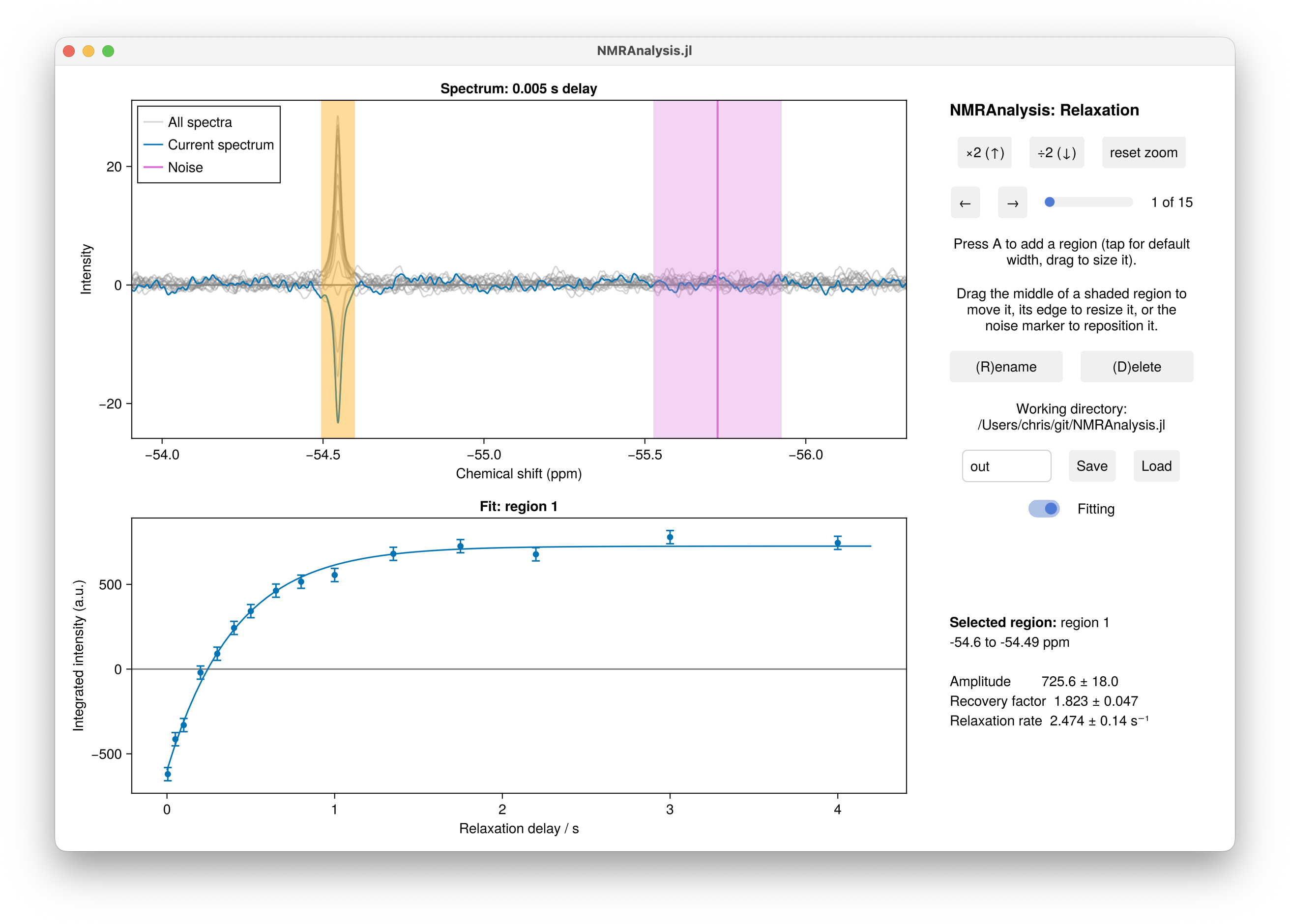
That reads experiment 11, works out the delays and the model (see below), and opens the analysis window. Put the region over your signal, put the noise marker somewhere empty, check the fit, and press Save.
Delays and model
The delays and the model are found in the usual order of precedence. Nothing has to be annotated: if the delays cannot be found you are asked for them, and if the model cannot be found you are offered the choice.
| From an argument | From an annotation | From the acquisition parameters | Otherwise | |
|---|---|---|---|---|
| Delays | tau=[0.01, 0.05, …] | relaxation.duration | the vdlist | you are asked |
| Model | model=:exponential or :recovery | relaxation.model | you choose from a menu |
relaxation1d("11"; tau=[0.01, 0.03, 0.06, 0.1])   # delays given explicitly
relaxation1d("11"; model=:recovery)               # fit a recovery curve
relaxation1d("11"; tau=collect(0.01:0.01:0.1), model=:exponential)   # nothing asked
Delays are always in seconds.
What is fitted
An exponential decay,
\[I(t) = A \exp(-Rt),\]
or, for model = :recovery, an inversion or saturation recovery,
\[I(t) = A \left[ 1 - C \exp(-Rt) \right].\]
| Parameter | Meaning |
|---|---|
A | Amplitude |
R | Relaxation rate, s⁻¹ |
C | Recovery factor, for a recovery fit only. Ideally 2 for a complete inversion |
The relaxation time is 1/R. param(results[1], :R) gives the rate with its uncertainty, so 1 / param(results[1], :R) gives the time with the uncertainty propagated.
Automatic dispatch
A pulse sequence annotated with types "1d" and "relaxation", and a feature of "R1" or "R2", is recognised by analyse:
analyse("11")Notes
For an inversion recovery, step to the last spectrum before positioning the region: that is where the signal has recovered most and is easiest to see.
The uncertainty on each integral comes from the noise marker, so it depends on a flat baseline there. See Uncertainties.